The materials we run across SLA, Carbon DLS, CNC machining and vacuum casting, and how to choose between them.
Complete Fabrication runs materials across SLA, DLP, Carbon DLS, FDM, CNC machining and vacuum casting. We help you choose the one that meets your performance, cost and compliance needs, and we tell you when a substitution would need redesign. Data sheets are on the data sheets page.
For an overview of material families, from biocompatible polymers to high-temperature and clear plastics, see our material options guide.
| Process | Good for | Materials below |
|---|---|---|
| SLA | Fine detail, clear parts, vacuum casting masters, tough replacements for ABS and polypropylene | 7 resins |
| DLP | Flexible, rigid, high-temperature and nylon-like parts | 9 resins |
| Carbon DLS | Functional and end-use parts, elastomers, biocompatible-capable parts | 9 resins |
| FDM | Functional prototypes in engineering filaments | 8 filaments |
Start from what the part has to do. This table points to the materials we run that suit each need, with the figure that matters most.
| What the part needs | Materials to consider | Key figure |
|---|---|---|
| Clear, see-through parts | Somos WaterClear Ultra 10122 and MPC12 Clear (SLA); 6095 Clear (vacuum casting) | WaterClear: refractive index 1.52. 6095 Clear: UV-stabilised, Shore D 82 |
| Snap fits and polypropylene-like parts | Accura 25 and Accura Xtreme (SLA); Renishaw 8045 and PX 212 L (vacuum casting) | Accura Xtreme: 14 to 22% elongation. Renishaw 8045: 55 to 75% elongation |
| Rigid parts that behave like ABS or polycarbonate | Accura Xtreme White 200 (SLA); PX 225 OP (vacuum casting) | PX 225 OP: flexural modulus about 2,500 MPa, similar to polycarbonate or ABS |
| Highest strength and stiffness | Bambu PPA-CF (FDM); EPX 86FR and EPX 82 (Carbon DLS) | PPA-CF: 168 MPa tensile in the print plane. EPX 86FR: 90 MPa |
| Heat resistance above 200 °C | SuperHDT, Loctite IND147 and Liqcreate Flame Retardant HDT (DLP); Bambu PPA-CF (FDM) | HDT 240 °C, 235 to 291 °C, 237 °C and 227 °C |
| Flame retardance | EPX 86FR (Carbon DLS); Liqcreate Flame Retardant HDT (DLP) | EPX 86FR: UL 94 V-0 at 2.0 mm. Liqcreate: UL94 V0 at 3.0 mm |
| Rubber-like, flexible parts | EPU 40, EPU 45, EPU Pro 50 and 90 and SIL 30 (Carbon DLS); Flexible-X (DLP); TPU 90A and Flex TPU Air (FDM); Poly PT Flex (casting) | Hardness from Shore A 20 to Shore A 90 |
| Skin contact | SIL 30 and EPU Pro 50 Black (Carbon DLS) | EPU Pro 50 Black met the ISO 10993-5, -10 and -23 tests in its data sheet |
| Biocompatible, sterilisable parts | MPU 100 (Carbon DLS) | Carbon pairs it with biocompatibility and sterilisability; 25% elongation |
| Living hinges and parts under repeated flexing | FPU 50 (Carbon DLS) | 280% elongation; impact, abrasion and fatigue resistant (limited availability) |
| Outdoor parts and UV exposure | Eryone ASA-CF and The Filament ASA CF (FDM) | UV-resistant ASA; Eryone rates its ASA-CF 60% stiffer than ordinary ASA |
| Moulds and tooling | Loctite IND147 and Rigid110 (DLP) | IND147 is made for polyurethane and silicone moulding |
| Fine detail models | AMD-3 (DLP) and our SLA resins | AMD-3: low shrinkage, Shore D 85 |
| Tough parts that are drilled and tapped | Sunlu Nylon-Like (DLP) | 48% elongation; 108 J/m notched impact |
| Metal parts or the production plastic | CNC machining in aluminium, steels, stainless steel, brass, PEEK and engineering plastics | See CNC machining |
Typical values from each maker's data sheet, as given on the material pages. HDT is at 0.45 MPa unless stated. Makers use different test methods, so treat comparisons between makers as a guide and check the data sheet before you choose.
Laser resins we run on our SLA machines.
| Material | Maker | What it is | Key figures | Data sheet |
|---|---|---|---|---|
| Accura Xtreme grey | 3D Systems | Ultra-tough grey plastic that replaces CNC-machined polypropylene and ABS parts | Thermal resistance over 60 °C. Shore D 86 | TDS and SDS |
| Accura Xtreme White 200 | 3D Systems | Tough white plastic for snap fits, assemblies and vacuum casting masters | Tensile 45 to 50 MPa. Elongation 7 to 20% | TDS |
| Accura 25 | 3D Systems | Flexible polypropylene-class plastic for snap fits and durable functional prototypes | Tensile 38 MPa. Elongation 13 to 20% | TDS |
| MPC12 clear | Additive Manufacturing Materials | Clear multipurpose resin for functional prototypes, RTV casting masters and investment casting patterns | Built for 355 nm solid-state lasers | TDS |
| Somos WaterClear Ultra 10122 | Somos | Optically clear resin with an acrylic-like look, for clear parts, fluid flow models and masters | Shore D 87. Elongation 7.5% | TDS |
| Rapid Pro Grey (R4PID) | R4PID | Light grey rigid resin for 355 nm systems | Tensile 50 to 56 MPa. Shore D 80. HDT 56 to 61 °C at 0.45 MPa | TDS |
| Rapid White (R4PID UK1618) | R4PID | Matte white resin for 355 nm systems | Tensile 40 to 44 MPa. Elongation 8 to 12%. HDT 49 to 61 °C | TDS |
The same figures for each SLA resin, side by side.
| Resin | Good for | Tensile strength | Elongation at break | HDT | Hardness |
|---|---|---|---|---|---|
| Accura Xtreme | Replacing machined polypropylene and ABS: enclosures, snap fits, short runs | 38 to 44 MPa | 14 to 22% | 62 °C | Shore D 86 |
| Accura Xtreme White 200 | Demanding assemblies, snap fits and vacuum casting masters; takes paint well | 45 to 50 MPa | 7 to 20% | 47 °C | Shore D 78 to 80 |
| Accura 25 | Simulating white polypropylene; snap fits and durable functional prototypes | 38 MPa | 13 to 20% | 58 to 63 °C | Shore D 80 |
| Rapid White (UK1618) | Functional prototypes and assembly fit tests; sands and paints well | 40 to 44 MPa | 8 to 12% | 49 to 61 °C | Shore D 78 to 80 |
| Rapid Pro Grey | Stiff housings, clips, brackets, fixtures and instrument parts | 50 to 56 MPa | 4 to 7% | 56 to 61 °C | Shore D 80 |
| MPC12 Clear | Clear functional prototypes, silicone mould masters and our largest SLA parts | 50 to 56 MPa | 8 to 15% | 49 °C | Not stated |
| Somos WaterClear Ultra 10122 | Optically clear parts: lenses, light pipes and fluid flow models | 56 MPa | 7.5% | 47 °C (0.46 MPa) | Shore D 87 |
Typical values from the makers' data sheets. HDT is at 0.45 MPa unless stated.
Resins for our DLP printers, in the 385 to 405 nm range.
| Material | Maker | What it is | Key figures | Data sheet |
|---|---|---|---|---|
| Liqcreate Flexible-X | Liqcreate | Extremely flexible, soft black resin for DLP, LCD and laser printers | Shore A 55 | TDS |
| Rigid110 | Magforms Technology | Rigid, high-strength resin for 405 nm DLP and LCD printers, suited to shell parts and mould masters | Shore D 85 | TDS |
| Crys200 | See data sheet | A family of 405 nm DLP resins. We can run all grades | See data sheet | Specifications |
| Loctite 3D IND147 High Temperature Black | Henkel | High-temperature resin for tooling and moulds, such as polyurethane and silicone moulding | HDT above 230 °C | TDS |
| Liqcreate Flame Retardant HDT | Liqcreate | Flame-retardant, high-temperature grade | See data sheet | TDS |
| TR300 engineering heat-resistant resin, grey | Phrozen | Engineering resin for heat resistance | HDT 65 °C as printed, up to 160 °C depending on post-cure | SDS and User guide |
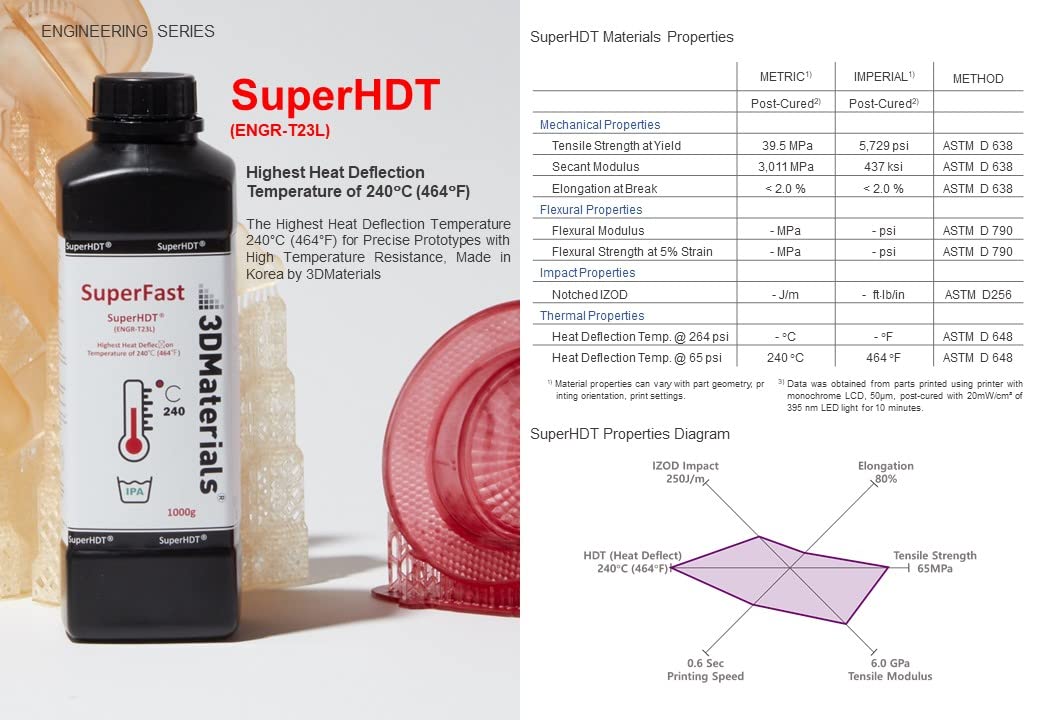
| SuperHDT (ENGR-T23L) | 3DMaterials | Engineering resin with the highest heat deflection temperature in this list | HDT 240 °C. Tensile 39.5 MPa at yield. Elongation under 2% | Data sheet (image) |
| AMD-3 high resolution models | Amera Labs | Hard, low-shrinkage resin for fine detail, in black or grey, for LED, LCD and DLP printers | Shore D 85 | TDS |
| Nylon-Like Resin | Sunlu | Tough, nylon-style resin with a matte finish that can be drilled and tapped | Tensile 35 MPa. Elongation 48%. Shore D 80. HDT 50 °C | TDS |
Our DLP resins cover the extremes: very soft, very hot and flame-retardant parts.
| Resin | Good for | Tensile strength | Elongation at break | HDT | Hardness |
|---|---|---|---|---|---|
| Rigid110 | Rigid shell parts and mould masters | 42.7 MPa | 33.1% | 65 °C (maker's method) | Shore D 85 |
| AMD-3 | High-resolution, low-shrinkage detail models | 65.2 MPa | 3.3% | 128 °C | Shore D 85 |
| Sunlu Nylon-Like | Tough, nylon-style parts that can be drilled and tapped | 35 MPa | 48% | 50 °C | Shore D 80 |
| Phrozen TR300 | Heat-resistant engineering parts | 56.5 MPa as printed; 88.6 MPa after a 150 °C cure | Not stated | 65 °C as printed; 149 to 160 °C after thermal cure | Shore D 80 to 85 |
| SuperHDT (ENGR-T23L) | Prototypes that must survive very high temperatures; brittle | 39.5 MPa at yield | Under 2% | 240 °C | Not stated |
| Loctite 3D IND147 | Tooling and moulds for polyurethane and silicone moulding | 67 MPa | 2.4% | 235 to 291 °C | Shore D 94 |
| Liqcreate Flame Retardant HDT | Flame-retardant parts for electronics, aviation, automotive and rail | 41 MPa | 1 to 3% | 237 °C | Shore D 88 |
| Liqcreate Flexible-X | Soft-touch, elastic parts | 2.4 MPa | 120 to 160% | Not applicable | Shore A 55 |
Typical values from the makers' data sheets. HDT is at 0.45 MPa unless stated. Crys200 grades are on their own data sheet.
Resins for our Carbon DLS printers.
| Material | Maker | What it is | Key figures | Data sheet |
|---|---|---|---|---|
| MPU 100 | Carbon | Strength with biocompatibility and sterilisability | Tensile 38 MPa. Elongation 25% | TDS |
| EPX 82 | Carbon | Functional toughness, stiffness and temperature resistance for automotive, industrial and consumer parts | See data sheet | TDS |
| EPX 86FR | Carbon | Flame-retardant, high-strength, with long-term stability. Includes a UL Blue Card certificate | See data sheet | TDS |
| RPU 70 | Carbon | Tough, rigid material for parts needing strength and moderate heat resistance | See data sheet | TDS |
| FPU 50 | Carbon | Semi-rigid, impact, abrasion and fatigue resistant, for living hinges and friction fits. The sheet marks it limited availability | See data sheet | TDS |
| EPU 40 | Carbon | Polyurethane elastomer with high elasticity and tear resistance | Tensile 19 MPa. Elongation 400% | TDS |
| EPU 45 | Carbon | Energy-damping elastomer | See data sheet | TDS |
| EPU Pro 50 and 90 Black | Carbon | Single-part elastomers with tunable stiffness and extended pot life | See data sheet | TDS |
| SIL 30 | Carbon | Soft, tear-resistant silicone urethane elastomer for skin-contact parts | Tensile 3.2 MPa. Elongation over 330% | TDS |
Rigid resins first, then elastomers. Carbon gives HDT at 0.455 MPa.
| Resin | Good for | Tensile strength | Elongation at break | HDT | Hardness or rating |
|---|---|---|---|---|---|
| EPX 82 | Strong, heat-resistant automotive, industrial and consumer parts | 80 MPa | 5% | 130 °C | UL 94 HB |
| EPX 86FR | Parts that need UL 94 V-0 or FAR 25.853(a) flame performance | 90 MPa | 5% | Not stated | UL 94 V-0 at 2.0 mm |
| RPU 70 | Tough, rigid parts with moderate heat resistance | 40 MPa | 30% | 60 °C | UL 94 HB |
| MPU 100 | Strong parts that need biocompatibility and sterilisation | 38 MPa | 25% | 48 °C | Not stated |
| FPU 50 | Living hinges, friction fits and parts under repeated stress (limited availability) | 29 MPa | 280% | 78 °C | Shore D 71 |
| EPU 40 | Elastic, tear-resistant rubber-like parts | 19 MPa | 400% | Not applicable | Shore A 72 |
| EPU 45 | Parts that absorb shock and vibration | 24 MPa | 290% | Not applicable | Shore A 77 |
| EPU Pro 50 / 90 Black | Soft (50) or firm (90) elastomer parts, from development to production | 14 / 22 MPa | 820% / 440% | Not applicable | Shore A 53 / 88 |
| SIL 30 | Soft, comfortable skin-contact parts | 3.2 MPa | Over 330% | Not applicable | Shore A 35 |
Typical values from the makers' data sheets.
Data sheets for eight of the filaments we run on our FDM printers. The wider range also includes PLA, ABS, PC, PAHT-CF, PET-CF, PPS-CF and foaming grades, so ask if you need one that is not listed. For how we print and finish them, see FDM 3D printing.
| Material | Maker | What it is | Key figures | Data sheet |
|---|---|---|---|---|
| eSUN PETG | eSUN | Tough, translucent filament with water and chemical resistance, tougher than ABS | Density 1.27 | TDS |
| Eryone ASA-CF | Eryone | Outdoor filament with UV and cold-weather resistance, carbon-fibre filled | Stiffness 60% higher than standard ASA | TDS |
| The Filament ASA CF | The Filament | ASA, carbon-fibre filled | See data sheet | TDS |
| Bambu PPA-CF | Bambu Lab | Fibre-reinforced PPA for humid or high-temperature use, mechanical prototypes and automotive parts | See data sheet | TDS |
| Bambu PA6-GF | Bambu Lab | Nylon 6 with glass fibre for strength, durability and dimensional stability | See data sheet | TDS |
| Eryone PA6-CF | Eryone | Nylon 6 with about 20% carbon fibre | See data sheet | TDS |
| Bambu TPU 90A | Bambu Lab | Flexible, wear-resistant TPU for soles, tyres and functional parts | Hardness 90A | TDS |
| Siraya Tech Flex TPU Air Black | Siraya Tech | Foaming flexible TPU up to 50% lighter than standard TPU, with a fabric-like matte finish | Hardness 63A to 78A, set by nozzle temperature | TDS |
FDM parts are weaker across the layers than along them, so the cross-layer (Z) strength is shown where the maker gives it.
| Filament | Good for | Tensile strength (X-Y) | Tensile strength (Z) | Elongation at break | HDT |
|---|---|---|---|---|---|
| eSUN PETG | Tough, translucent parts with water and chemical resistance | 52.2 MPa | Not stated | 83% | 64 °C (load not stated) |
| Eryone ASA-CF | Outdoor parts that need UV and cold resistance | 39.1 MPa | Not stated | 2.3% | 86 °C (load not stated) |
| The Filament ASA CF | UV-resistant parts with a matte carbon-look finish | 59 MPa at break | Not stated | 2% | 88 °C (load not stated) |
| Bambu PPA-CF | Very stiff parts for hot or humid conditions, such as automotive parts | 168 MPa | 57 MPa | 3.2% | 227 °C |
| Bambu PA6-GF | Strong, dimensionally stable engineering parts | 75 MPa | 27 MPa | 3.9% | 182 °C |
| Eryone PA6-CF | Stiff, strong nylon parts that see heat | 53 to 55 MPa | 47 to 53 MPa (X-Z) | 8.9 to 10.3% | 185 °C |
| Bambu TPU 90A | Flexible, wear-resistant parts such as soles and tyres | 12.5 MPa | 10.1 MPa | Over 650% | Not applicable |
| Siraya Tech Flex TPU Air | Light, soft parts with a fabric-like finish; Shore A 63 to 78 | 3.8 to 10.3 MPa, set by nozzle temperature | Not stated | 475 to 629% | Not applicable |
Typical values from the makers' data sheets. HDT is at 0.45 MPa unless stated.
Aluminium, stainless steel, brass and solid PEEK, plus engineering plastics such as ABS, polycarbonate and nylon. We can source all grades and carry a large selection in stock. Call +44 1223 836837 if you need more information.
Vacuum casting data sheets: Renishaw 8045, 6095 Clear, PX 212 L, PX 225 OP and Poly PT Flex.
Cast polyurethanes are chosen to behave like a production plastic or rubber.
| Material | Behaves like, or good for | Tensile strength | Elongation | Hardness | Heat resistance |
|---|---|---|---|---|---|
| Renishaw 8045 | Translucent polypropylene and polyethylene-type parts; high-impact parts and snap fits | 10 to 32 MPa, set by mix | 55 to 75% | Shore D 48 to 74 | HDT 35 to 79 °C |
| Axson PX 212 L | Technical parts with the stiffness of polypropylene or HDPE; excellent impact resistance | 40 MPa | 10% | Shore D 76 | HDT 75 °C (ISO 75 Ae) |
| Axson PX 225 OP | Opalescent technical parts with the stiffness of polycarbonate or ABS; takes pigment | 70 MPa | 9% | Shore D 85 | Tg 100 °C |
| 6095 Clear | Hard, clear, UV-stabilised parts | 60 MPa | 30% | Shore D 82 | HDT 80 °C (1.80 MPa) |
| Poly PT Flex | Rubber parts for indoor use; not for food or body contact | 250 to 1,064 psi (about 1.7 to 7.3 MPa) | 175 to 770% | Shore A 20 to 85 | Not stated |
Typical values from each maker's data sheet. Renishaw 8045 and Poly PT Flex ranges cover the different mix ratios and grades.
We run certified biocompatible materials on our Carbon DLS printers and offer equivalent resins for vacuum cast batches. For high temperatures we offer options across Carbon DLS, FDM and SLA, specialised casting resins, and CNC-machined solid PEEK. We can also source medical grade polymers and elastomers.
We track RoHS, REACH and FDA requirements, and supply Certificates of Conformity for manufacture and materials as standard when you ask at the quote stage.
Yes, but it needs testing and validation. We assess the effect on performance, cost and timeline. Some substitutions need no design changes and others need a redesign, and we tell you which.
We keep common prototyping materials in stock. For production runs we source against your specification and volume, and plan the lead time with you.
RoHS, REACH and FDA requirements. Medical devices need biocompatibility data, and automotive parts need specific grades. We supply Certificates of Conformity on request.
Accura Xtreme grey, Accura Xtreme White and Accura 25 on SLA are used to replace machined ABS and polypropylene parts. Carbon DLS materials are also matched to common thermoplastics.
MPC12 and Somos WaterClear Ultra 10122 on SLA, and clear polyurethane resins in vacuum casting. SLA parts can be polished or clear-coated to a water-clear finish.
SuperHDT, a DLP resin with a heat deflection temperature of 240 °C, and Loctite 3D IND147, above 230 °C. For FDM parts working at around 120 °C and above, PPA-CF and PPS-CF are the grades we look at first. For higher temperatures we also CNC machine solid PEEK.
Carbon EPU 40, EPU 45, EPU Pro and SIL 30 on Carbon DLS, TPU on FDM, and cast RTV silicones and polyurethane elastomers across most Shore hardnesses. See flexible gaskets.
Carbon MPU 100 is biocompatible and sterilisable, and SIL 30 is a soft material for skin contact. We also cast biocompatible polyurethane resins for vacuum cast batches. We supply the material data for your own assessment.
Carbon EPX 86FR and Liqcreate Flame Retardant HDT in resin, and flame-retardant PC on FDM. Check each data sheet for the rating you need, or tell us the standard the part has to meet.
Engineering plastics including ABS, nylon, acetal, polycarbonate, acrylic and PEEK. See CNC machining.
See also:3D printing in Cambridge, vacuum casting, medical device prototyping, what affects the price and rapid prototyping FAQs. To get a quote, contact us.