Low-volume SLA printing from one part to hundreds, made at our workshop in Whittlesford, near Cambridge. ISO 9001 certified, with a firm lead time quoted up front.
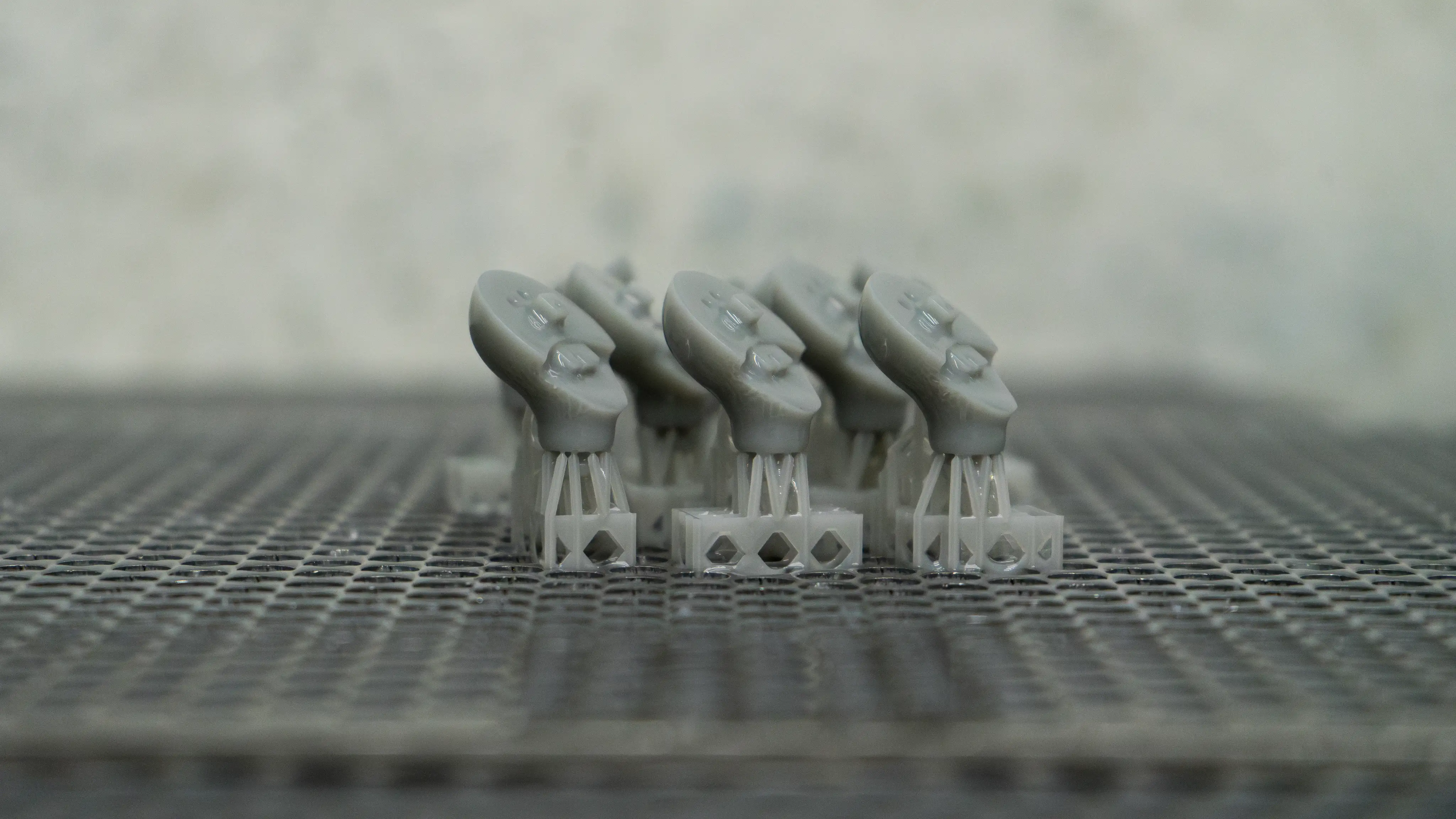
SLA batch production means printing a run of identical stereolithography (SLA) parts, from a handful to a few hundred, without making a tool first. Complete Fabrication runs batches in our Whittlesford workshop near Cambridge, then paints, polishes or assembles them in the same building, so one team is responsible from file to finished parts.
Per-part cost falls as quantity rises, because setup, file checking and build preparation are shared across the run. Exact prices depend on part size, material, finish and deadline, so we quote each job from your CAD file rather than publish a rate card. This table shows what changes at each quantity.
| What changes | 1 unit | 50 units | 200 units |
|---|---|---|---|
| Cost per part | Highest: one part carries all the setup | Lower: setup and file checks are shared | Lowest of the three: quoted per job |
| Build preparation | One part laid out and supported | One layout repeated across several builds | Layout planned and proven once, then repeated |
| Finishing | Done by hand on one part | Hand time grows with part count | The biggest cost driver, so we agree the finish early |
| Lead time | 24 hours as standard | Firm timeline given at quote | Planned across build runs, with a firm schedule at quote |
| Best process | SLA | SLA, or vacuum casting for suitable parts | SLA, vacuum casting or Carbon DLS, priced side by side |
See our pricing guide for the factors that set the price of any job.
Vacuum casting usually becomes cheaper per part once you need several tens of identical parts, because one silicone mould makes around 20 castings and its cost is spread across the batch. There is no single crossover quantity: it depends on part size, geometry and material, so we price both routes from your CAD file and tell you which is cheaper. Below that point SLA wins, because it needs no master pattern or mould and is ready sooner. Vacuum casting adds a pattern and mould stage and typically takes two to three weeks from pattern approval. See our vacuum casting service for batch sizes and tolerances.
The choice can also come down to how much finishing you need. If you need several clear parts, vacuum casting can mean less finishing than SLA, because each SLA part is finished individually while castings are taken from one mould. Tell us the finish you want and we compare the two routes on total cost, not print cost alone.
For functional parts in repeatable batches with injection-moulding-like strength, we also run Carbon DLS, which needs no tooling either.
We check every file before printing and tell you if a change would make the part stronger, cleaner or cheaper to make. There is no minimum order.
Our SLA resins include Accura Xtreme grey, MPC12 clear, Rapid White and Somos WaterClear Ultra 10122. The full list is on the materials page. SLA parts hold ±0.15 mm. Parts come off the machine or bead blasted as standard, and we paint, polish or plate them in house. Complete Fabrication is ISO 9001 certified (certificate 7774, ISOQAR, UKAS).
Send your CAD file and quantity to Info@compfab.co.uk, call +44 1223 836837, or use the contact page.
It is printing a run of identical SLA parts, from a few to a few hundred, without tooling. Each part is made from your CAD data, so the design can change between runs.
No. We make single prototypes as well as batches, with no minimum order.
Per-part cost falls as quantity rises, because setup and build preparation are shared across the run. The saving depends on part size, material and finish, so we quote each job from your CAD file.
Usually once you need several tens of identical parts, because one silicone mould makes around 20 castings and its cost is spread across the batch. It can also come down to finishing: for several clear parts, vacuum casting can need less finishing than SLA. The exact crossover depends on the part, so we price both routes and tell you which is cheaper.
SLA parts are ready in 24 hours as standard, with no rush fee. Larger batches are given a firm timeline when we quote.
SLA parts hold ±0.15 mm. Vacuum casting holds ±0.5 mm on most dimensions.
Related pages:SLA printing, 3D printing in Cambridge, vacuum casting, low-volume production, pricing and prototyping FAQ.