Tough prototypes and working parts in PETG, carbon-fibre ASA, filled nylons and flexible TPU, printed and finished at our workshop in Whittlesford, near Cambridge.
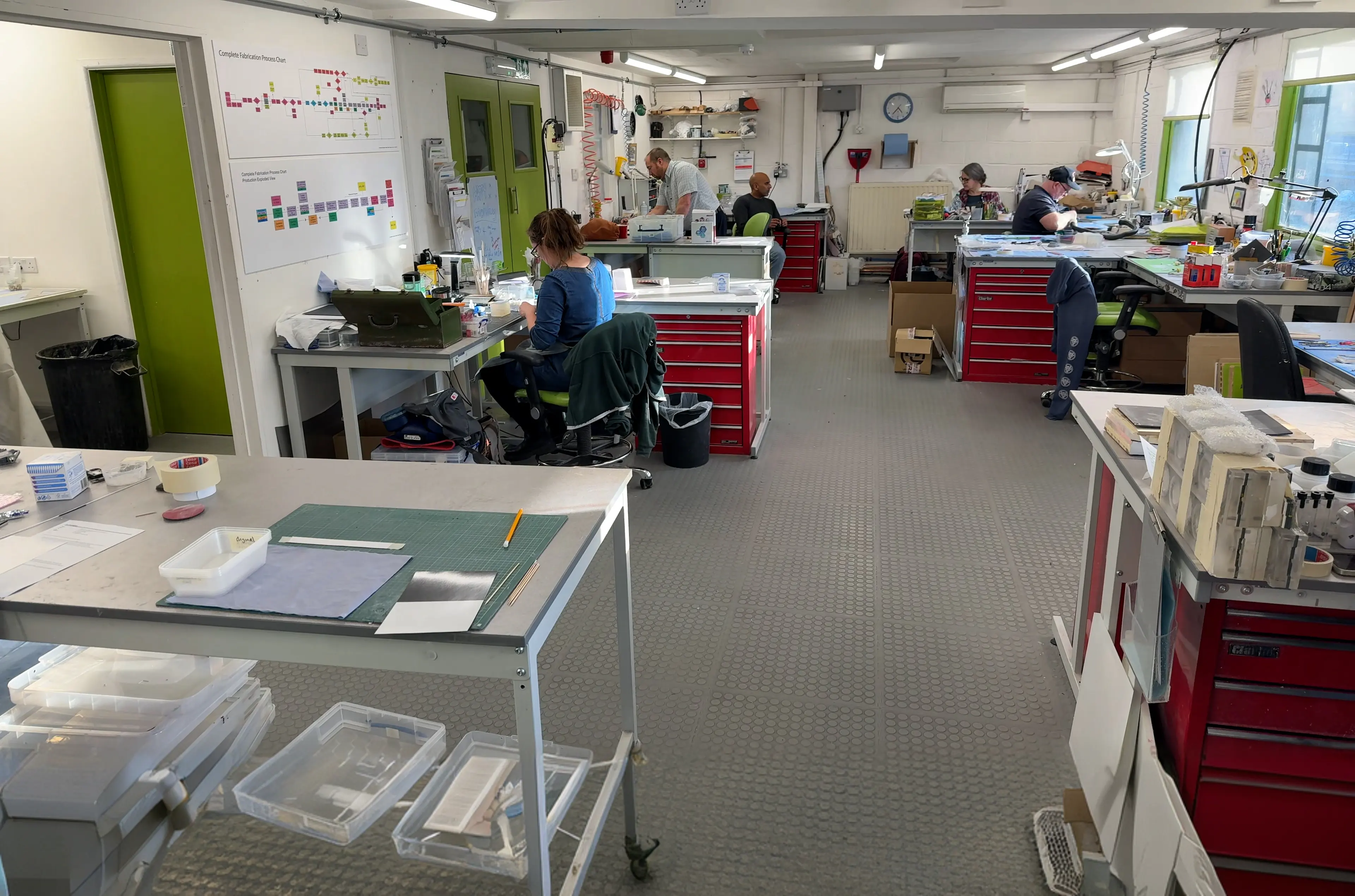
FDM (fused deposition modelling) builds a part by laying down melted thermoplastic filament, layer by layer, so the part is made from a real engineering thermoplastic such as nylon, ASA, PETG or TPU. Complete Fabrication runs FDM alongside SLA, Carbon DLS, CNC machining and vacuum casting at our workshop in Whittlesford, near Cambridge, so we can tell you when FDM is the right process and when another one will do the job better.
| Material | What it is | Key figures |
|---|---|---|
| eSUN PETG | Tough, translucent filament with water and chemical resistance | Tensile 52.2 MPa, HDT 64 °C |
| Eryone ASA-CF | Carbon-fibre ASA for outdoor parts, UV and cold resistant | Tensile 39.1 MPa (X-Y), HDT 86 °C |
| The Filament ASA CF | 3% carbon-fibre ASA, UV resistant | Tensile 66 MPa at yield, HDT 88 °C |
| Bambu PA6-GF | Glass-fibre nylon 6 for strong, dimensionally stable parts | Tensile 75 MPa (X-Y), HDT 182 °C |
| Eryone PA6-CF | Carbon-fibre nylon 6 | Tensile 53 to 55 MPa, HDT 185 °C |
| Bambu PPA-CF | Carbon-fibre PPA for parts that must stay stiff in heat or humidity | Tensile 168 MPa (X-Y), HDT 227 °C |
| Bambu TPU 90A | Flexible, wear-resistant TPU | Shore 90A, elongation over 650% |
| Siraya Tech Flex TPU Air | Foaming TPU, up to 50% lighter than standard TPU | Shore 63A to 78A, elongation over 475% |
Figures are typical values from the manufacturers' data sheets. FDM parts are weaker between layers than along them, so tell us how the part will be loaded and we will plan the build orientation around it. See every material we run on the materials page.
Choose FDM when you want a real thermoplastic, a tough functional part or a quick form check. Choose SLA for fine detail, a smooth surface ready for painting, or clear parts, with a 24-hour standard turnaround. Choose Carbon DLS for production-quality parts with injection-moulding-like strength in every direction. If you are not sure, send the CAD and we will recommend one.
FDM parts are finished in the same building they are printed in. We paint, assemble and fit inserts in-house, so one team is responsible from file to finished part.
FDM turnaround depends on part size and finish, and we give you a firm timeline when we quote. Send your CAD file, the material and the quantity to Info@compfab.co.uk, call +44 1223 836837, or use the contact page. We check every file before printing and tell you if a change would make the part stronger, cleaner or cheaper to make.
Fused deposition modelling builds a part by extruding melted thermoplastic filament layer by layer, so parts are made from real engineering thermoplastics such as nylon, ASA, PETG and TPU.
Of the filaments we run, Bambu PPA-CF has the highest heat deflection temperature at 227 °C, followed by Eryone PA6-CF at 185 °C and Bambu PA6-GF at 182 °C.
Yes, in Bambu TPU 90A, or in Siraya Tech Flex TPU Air, which foams as it prints to make parts up to 50% lighter than standard TPU.
No. SLA holds ±0.15 mm and gives a much finer surface. Use FDM where toughness or a real thermoplastic matters more than fine detail.
Related pages:SLA printing, Carbon DLS, 3D printing in Cambridge, SLA batch production, materials and data sheets and what affects the price.