Appearance models, functional prototypes and clinical-trial batches, in biocompatible materials where you need them.

Complete Fabrication makes prototypes and small batches for medical device teams from its workshop in Whittlesford, near Cambridge. We work in biocompatible materials, sign non-disclosure agreements as a matter of course, and supply the paperwork that goes with the parts. The company has been trading since 1986 and is ISO 9001 certified.
We run certified biocompatible materials on our Carbon DLS printers, such as MPU 100 and SIL 30, and offer equivalent resins for vacuum cast batches. For skin-contact testing or surgical trials we supply the material data you need for your own assessment.
To compare materials side by side, see our material selection guide. For how vacuum casting is used in medical work, read vacuum casting in the medical industry. For design choices that make devices safer to use, read medical device design and prototyping.
Planning pilot builds or trial batches? See small batch production for medical devices.
Complete Fabrication is ISO 9001 certified (certificate 7774, ISOQAR, UKAS). That covers our quality management system. Prototypes are not finished medical devices, so approvals remain with the device manufacturer.
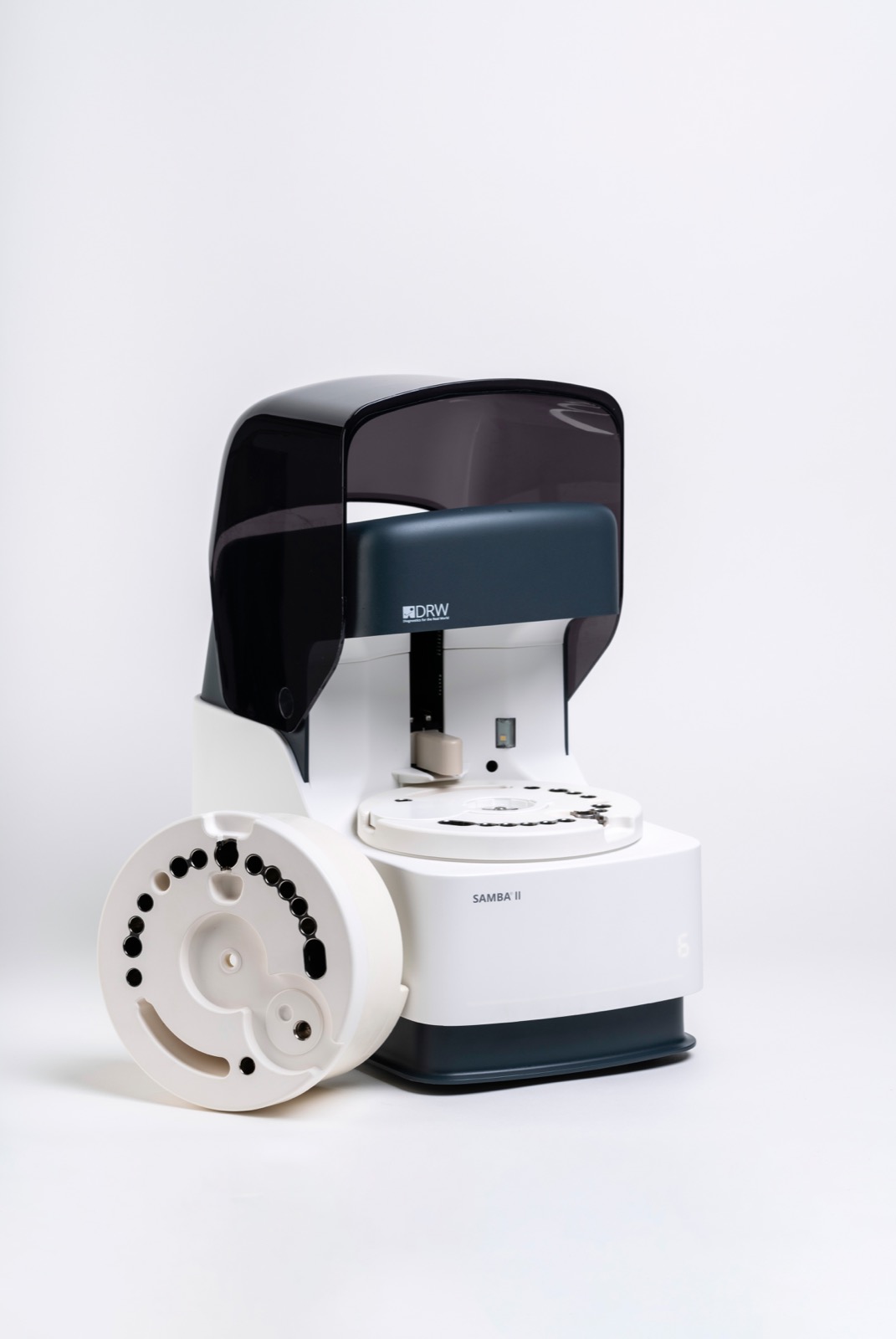


Diagnostics for the Real World (DRW), the company behind the SAMBA point-of-care diagnostics platform, designed the SAMBA II instrument for HIV testing on site, with results within hours rather than days or weeks.
What we made. We were the main supplier of the casework for the instrument and its printer, the protective covers and the sampling turret. We made the first working prototypes, then developed a bespoke solution to DRW's manufacturing problem and took it into full production in our workshop, including an urgent need during Covid. Production ran to about 20 to 30 finished units, several hundred parts in all: vacuum castings including clear tinted parts, a CNC-machined aluminium chassis and bespoke hard-tool mouldings, with large, complicated parts made repeatedly to a high degree of accuracy. We worked alongside DRW's metalworking, electronic control and in-house design engineers.
The turret. The sampling turret needed a specified level of insulation between its stainless steel pockets and had to stand up to medical-grade solvent cleaning. We developed an epoxy gel coat surface over a foamed epoxy body to meet both requirements.
Parts that clinicians will handle can be cleaned with medical-grade isopropanol wipes, or to a cleaning regime you specify. For each batch we record the materials, the pattern and mould numbers, who made the parts and the check results, and resin batch numbers can usually be traced. All of it, including the master patterns and silicone or hard tools, can be handed to you on request.
Yes. We run certified biocompatible materials on our Carbon DLS printers and offer equivalent resins for vacuum cast batches, for skin-contact testing and surgical trials. We supply the material data you need for your own clinical assessment.
Yes. Strict confidentiality is standard, and most medical work runs under a non-disclosure agreement.
Yes. We supply Certificates of Conformity for manufacture and for materials as standard, provided you flag the requirement when you ask for a quote.
Vacuum casting suits batches of 10 to 500 units, in resins that simulate production plastics. For small parts in larger numbers, Carbon DLS goes further: we have run batches of 1,000 small parts without tooling.
Yes. We CNC machine components from solid PEEK for demanding thermal environments, and we recommend checking the data sheet before we start.
Yes. There is no minimum order. We print single parts and small series in SLA and Carbon DLS, including biocompatible MPU 100, and Carbon DLS suits small parts in batches of up to 1,000. Vacuum casting covers 10 to 500 parts in resins that simulate production plastics.
Our case studies include the casework for the SAMBA II diagnostic instrument for Diagnostics for the Real World and casework for Owlstone breath analysers. We also print surgical guides, diagnostic housings and assemblies. See case studies.
Carbon MPU 100 is biocompatible and sterilisable. For other materials, check the data sheet against your sterilisation method, or ask us and we will check it.
Yes. We print surgical guides as well as diagnostic housings and assemblies, and we supply data sheets and Certificates of Conformity if you ask at the quote stage.
Yes. We print clear SLA parts in MPC12 and Somos WaterClear Ultra 10122, polished or clear-coated for fluidics, light pipes and see-through housings, and we vacuum cast clear polyurethanes for batches. See clear 3D printing.
Yes. If your project needs a Standard Operating Procedure or a specific Technical Agreement, we write it into the job workflow, and Certificates of Conformity for manufacture and materials are supplied when you ask at the quote stage.
Up to low-volume production, yes. SAMBA II went from our first working prototypes to about 20 to 30 finished units made in our workshop. For volume manufacture most devices move to injection moulding, and we can make bridge batches by vacuum casting or Carbon DLS while the tooling is made.
Further reading:how to create 3D-printed medical prototypes and the advantages of small-scale production for medical prototypes.
Need identical devices for a usability study or clinical trial? See trial batches.
See also:3D printing in Cambridge, vacuum casting, materials and data sheets, what affects the price and rapid prototyping FAQs. To get a quote, contact us.