Vacuum casting or 3D printing? Print one to a few parts fast with no tooling; cast 10 to 500 identical, self-coloured parts. Comparison table and quantity guide.
By Sebastian Stanley. First published 6 November 2024. Updated November 2026 by Tom Davies-Kent, Director, Complete Fabrication.
Choose 3D printing when you need one to a few parts quickly, or the design is still changing: SLA turns a CAD file into a part in 24 hours as standard, with no tooling. Choose vacuum casting when you need 10 to 500 identical parts that look, feel and behave like injection mouldings: an SLA master and a silicone mould give around 20 self-coloured castings per mould, in polyurethanes that simulate production plastics. Many projects use both, printing while the design changes and casting once it settles.
| 3D printing | Vacuum casting | |
|---|---|---|
| Best quantity | One-offs and small runs while the design changes; SLA batches are typically 20 to 200 | 10 to 500 identical parts |
| Tooling | None | An SLA master and a silicone mould; around 20 castings per mould |
| Typical time | 24 hours as standard for SLA | About a week for 20 small parts; larger batches confirmed at quote |
| Tolerance | SLA ±0.15 mm | About ±0.2 mm on small parts, up to ±0.7 mm on large castings |
| Largest single part | 450 × 450 × 450 mm in SLA; up to 800 × 800 × 1,000 mm in FDM | 800 × 550 × 550 mm, with shots up to 3.5 kg |
| Materials | SLA resins, Carbon DLS resins and elastomers, FDM thermoplastics | Polyurethane, silicone and epoxy resins, from rigid to Shore A20 soft, including clear grades |
| Colour and finish | Printed in the resin colour, then painted or polished | Pigment mixed into the resin; the texture or gloss of the master carries through to every casting |
| Design changes | Change the CAD and print again | Need a new master and mould |
These are the figures we work to in our workshop in Whittlesford, near Cambridge. We confirm the tolerance and lead time for your part when we quote.
Quantity decides most jobs, because printing has no set-up cost and casting has a mould to pay for before the first part.
| Quantity | Usually the better route | Why |
|---|---|---|
| 1 to 5 | 3D printing | No mould to make, and the design can change between prints |
| 5 to 20 | Either | Printing avoids the mould; casting gives identical, self-coloured parts with a production finish once the design is frozen |
| 20 to 500 | Vacuum casting, or an SLA batch for small detailed parts | The mould cost is shared across around 20 castings, and every part matches |
| Small parts in the hundreds, up to about 1,000 | Carbon DLS | No tooling; we have run batches of 1,000 small parts |
| Thousands, design frozen | Injection moulding | Steel tooling becomes cheaper per part; vacuum casting can bridge the gap while the tool is made |
Vacuum casting uses two-part thermoset resins: polyurethanes from rigid to rubber-like, silicones and epoxies. A review of industrial vacuum casting found that these thermosets compare with injection mouldings in the shapes they can form, how faithfully they copy the mould and their material properties (Wortmann and Frese, 2022). That is why cast parts are used for functional prototypes, user trials and even finished products. We cast clear polyurethanes such as 6095 for windows and covers, elastomers such as Poly PT Flex from about Shore A20 to A85, and two hardnesses in one part, such as a rigid body with a soft-touch grip.
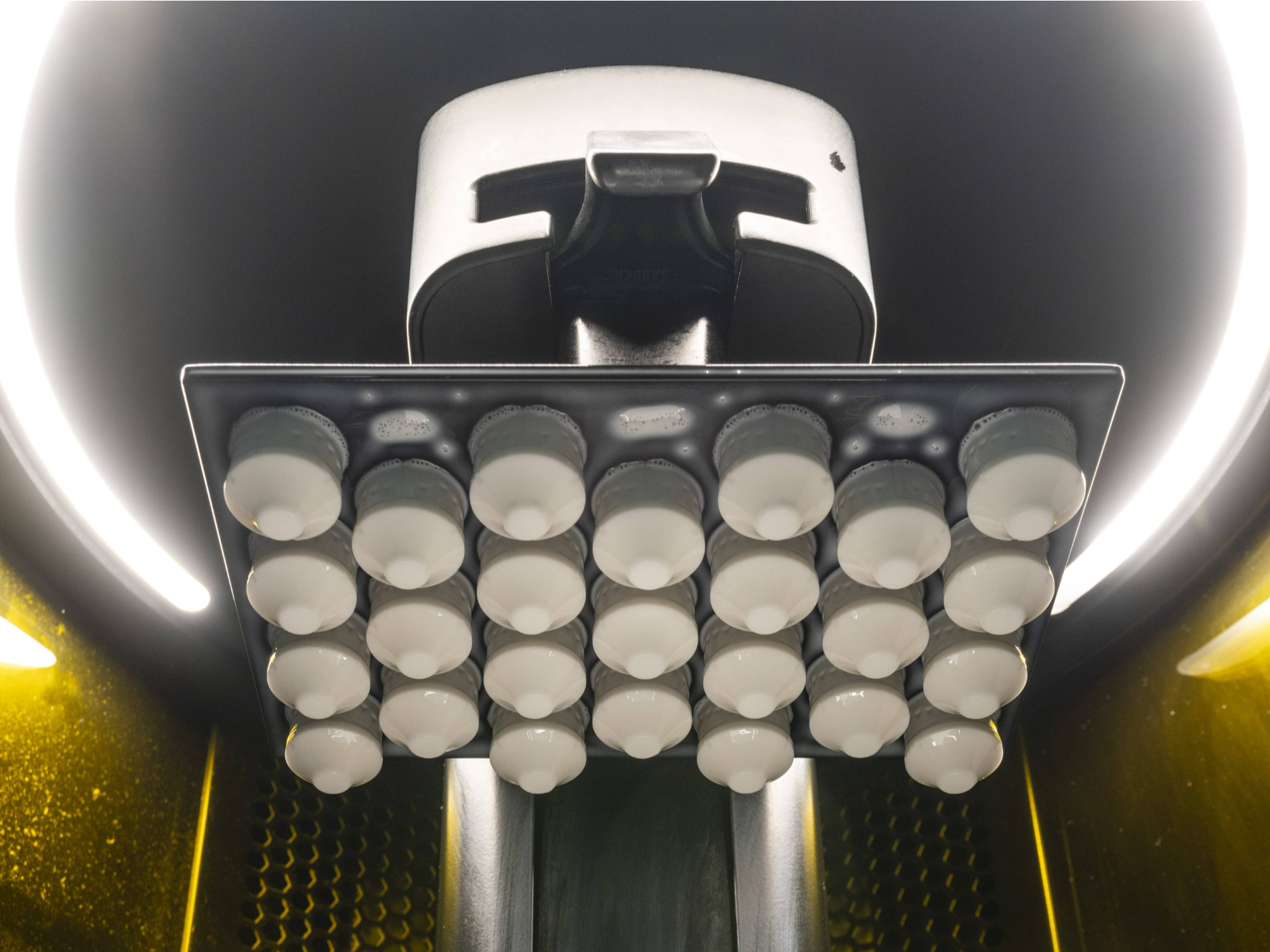
3D printing offers a different spread. SLA resins print fine detail and clear parts; ours have tensile strengths of 38 to 56 MPa, but they are stiffer and more brittle than moulded thermoplastics. Carbon DLS prints tough resins and elastomers with properties closer to an injection moulding. FDM prints real thermoplastics such as nylon, PC and carbon-fibre-filled grades. If the part must be in a specific production plastic, neither process copies it exactly: casting resins simulate it, and printed resins approximate it.
For one or two parts, printing is faster. SLA parts are turned round in 24 hours as standard, and CAD received by 5:30 pm is usually delivered the next day when capacity allows.
Casting adds two steps before the first part: printing and finishing the master, then making the silicone mould. As a guide, 20 small medical-device parts take about a week. After that, each extra casting adds little time, and because the colour is in the resin, many cast parts need no painting. A painted finish on a printed part adds at least a day, so for a batch of coloured parts the gap narrows.
The two processes spend money differently. With printing, cost rises almost directly with the number of parts and the finishing each one needs. There is no set-up charge, which is why additive manufacturing tends to be cost-effective for small batches (Thomas and Gilbert, 2014). Printed parts are not labour-free, though: supports are removed by hand, and a smooth painted finish means sanding every part.
Casting has a fixed cost first, for the master pattern and the moulds, then a low cost per casting. Moulds do not last for ever. Silicone absorbs part of the polyurethane resin at the cavity surface, which changes its hardness and strength over successive casts and limits mould life (Wortmann et al., 2021). We get around 20 castings from a mould, depending on the geometry and the resin, and make more moulds from the same master for larger batches. We quote each job from your CAD, because part size, resin, finish and quantity all move the price.
On small parts, SLA holds ±0.15 mm and vacuum casting about ±0.2 mm, with up to ±0.7 mm on large castings. Casting dimensions depend on the resin and the process, including the mould temperature (Spišák et al., 2021), which is why we confirm the tolerance for each part at quote.
Where casting pulls ahead is consistency and finish across a batch. Every casting copies the same master, so a gloss, a spark-eroded texture or a VDI finish applied to the master appears on every part. For many clear parts, casting also needs less hand finishing than printing and polishing each part one by one. Silicone moulds flex, so cast parts need no draft angles.
The master decides the result. As Jim, our Workshop Operations Manager, puts it: “A good master is one that has been designed or amended to suit the vacuum casting process. If the design works with the process rather than fighting against it, the results are better, the processing is easier and the unit price comes down.”
Most vacuum casting starts with a 3D print. We print the master in SLA, finish it to the surface you want, and make the silicone mould from it. The I-Dration water bottle followed that route: we printed the bottle in two parts in SLA, vacuum cast them in clear polyurethane and bonded the top and bottom for a watertight seal. The Owlstone breath analyser casework started as one- and two-off prototypes and grew over five years into vacuum cast runs of 10 to 30.
For metal parts, or tolerances tighter than either process holds, CNC machining works to ±0.10 mm on most work in the real material. For thousands of identical parts with a frozen design, injection moulding is usually cheaper per part. We do not injection mould, but we can check the design for manufacture first and make vacuum cast bridge batches while the tool is made.
It depends on quantity. For a few parts, printing is usually cheaper because there is no mould to make. For tens of identical parts, especially coloured ones, casting usually wins, because the master and mould cost is shared across the batch and the parts need little finishing.
Around 20 castings, depending on the part's geometry and the resin. Some resins are harder on the silicone, so a mould can give fewer. For larger batches we make more moulds from the same master.
Not on a single small part: SLA holds ±0.15 mm, and vacuum casting about ±0.2 mm on small parts and up to ±0.7 mm on large ones. Casting's advantage is that every part in the batch matches the same master.
Yes. Most of our masters are SLA prints, finished in-house to the surface the cast parts need.
Yes. We cast clear polyurethanes for windows and covers, and polyurethane elastomers and silicones for soft-touch grips and seals.
Single castings up to 800 × 550 × 550 mm, with shots of up to 3.5 kg. Larger items can be cast in sections and joined.
Send your CAD, the quantity and the finish you need, and we will tell you which route suits the job, or quote both. See our vacuum casting and 3D printing services, or contact us. For printing processes compared, read SLA vs FDM, and for the next step up in volume, vacuum casting vs injection moulding.
Send your CAD files or drawings and tell us when you need the parts. Call +44 1223 836837 or email info@compfab.co.uk.
Contact us