How resin 3D printing works, from photoinitiators and UV light to 0.05 mm layers, and why layer height, resolution and tolerance are different numbers.
By Tom Davies-Kent, Director, Complete Fabrication, with technical input from Chris, 3D Print Manager. Updated November 2026.
Resin 3D printing builds a part layer by layer, using light to turn liquid photopolymer into solid plastic. Layer height, resolution and tolerance are different figures: our SLA parts print at 0.05 mm layers but hold ±0.15 mm. Washing and UV curing after the print finish the job.
This guide covers the chemistry, the four ways light is delivered to the resin, and what each accuracy figure means. It ends with the design limits we work to and the research that is changing resins.
A photoresin is a liquid made of monomers and a photoinitiator. The monomers link into a solid polymer network. The photoinitiator starts that reaction when it absorbs light [7].
Two reaction routes are used, radical and cationic. The wavelength that works depends on the photoinitiator system [8].
Resins also react across a broad range of wavelengths, so white light can start curing too early. That is why high-resolution machines usually sit in light-controlled rooms, often lit yellow [7].
Most photoresins form permanent covalent bonds when they cure. The result is a rigid thermoset that cannot be reshaped or easily recycled [10].
Two measurements describe how a resin responds to light. Penetration depth is how far light travels into the resin.
Critical energy is the dose needed to start solidifying it. Research tests how light intensity changes both [9].
Charles Hull filed the first stereolithography patent in August 1984, and it was granted in March 1986 [1]. A 2020 review groups the technology that followed into four generations [2].
Stepwise layer-by-layer printing is slow, and continuous printing was developed to avoid that. Oxygen stops the resin curing next to the window, so a thin "dead zone" of liquid stays in place. The part never sticks to the window and can be drawn out continuously, in minutes instead of hours [4].

Carbon's DLS process, which we run as a Certified Production Partner, uses this principle. We also run SLA and DLP, and carry many DLP resins, including a few specialist ones. See our SLA and Carbon DLS pages.
Printers are often compared by layer height. That figure tells you how thin each slice is, not how close the finished part is to your CAD. Four terms get mixed up.
A 0.05 mm layer therefore does not mean ±0.05 mm. Four things widen the gap between layer height and tolerance:
A 2022 study tested SLA settings on castable wax patterns. Build angle and layer thickness were the two most influential settings for accuracy [6]. Geometric errors, such as roundness, were about twice the size of dimensional errors.
Z-direction dimensions were more accurate than X-Y dimensions in the same study. It used one material and one machine, so treat it as a guide, not a rule.
A part leaves the machine covered in uncured resin. Our route is:
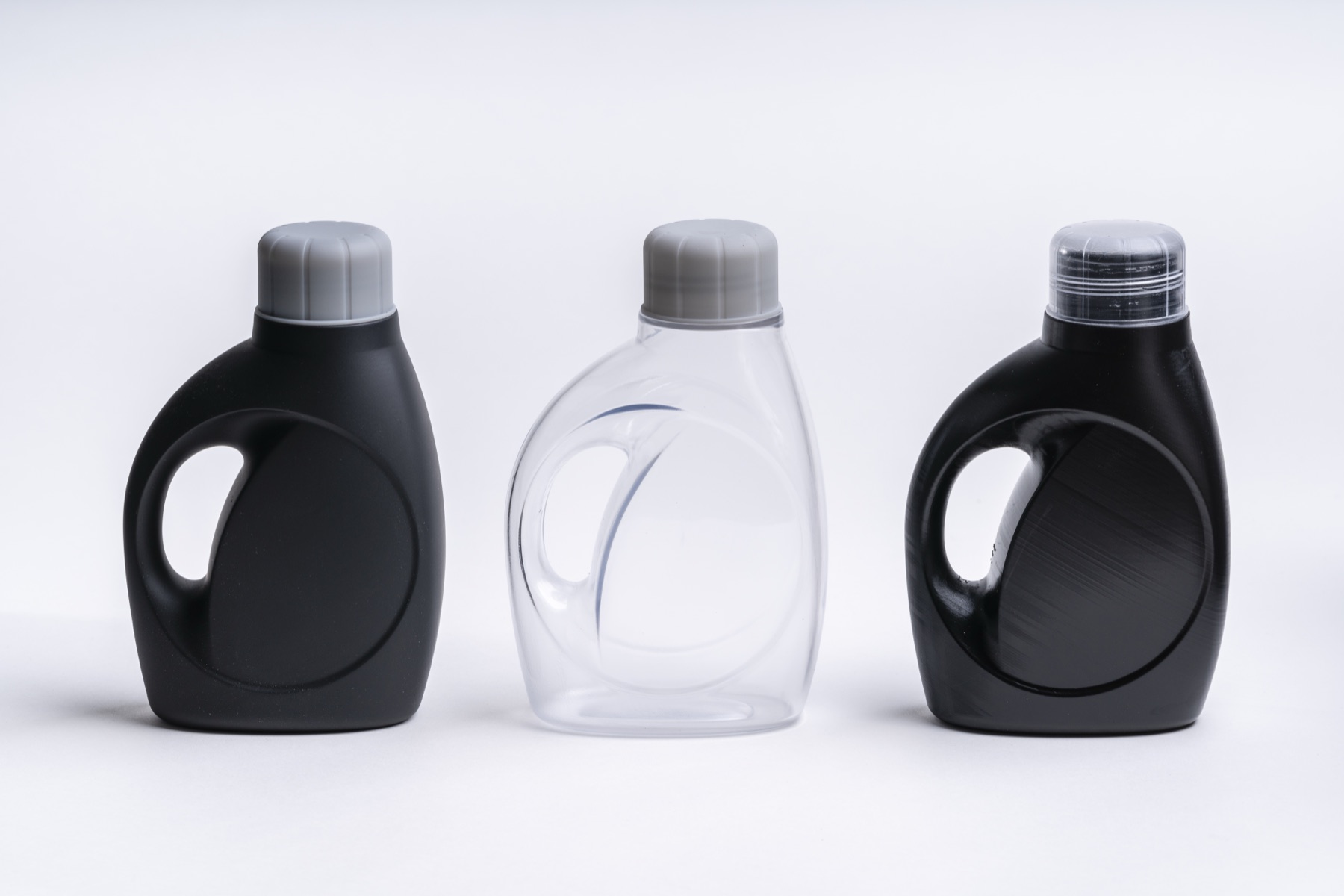
Paint changes dimensions. A gloss finish builds about 0.2 mm and satin or matt about 0.1 to 0.15 mm, so allow for it in every fit. Painting or polishing adds at least a day.
These figures depend on the machine and resin, so treat them as one workshop's numbers, not a standard.
Our SLA page lists the resins we print in.
Commercial light-based printers reach about 10 microns at best. Research printers go much finer. Heidelberg and Karlsruhe researchers print structures with nanometre resolution around cancer cell clusters, to hold them in place for testing [7].
Other work targets the resin. A 2024 review covers dynamic bonds that break and reform, giving resins that can self-heal, change shape or be recycled [10].
A second group makes resins from microalgae. The extracts were printed as inks without a separate photoinitiator, with sub-micron resolution [11].
None of this is on our machines today. It points to resins that last longer, can be recycled or come from renewable sources.
A printer exposes liquid photopolymer to light, one layer at a time, and each exposed area hardens. The platform moves a set distance after each layer. Our SLA machines print 0.05 mm layers.
SLA uses a laser to trace each layer. DLP uses a projector to cure the whole layer at once. We print SLA as our main process and also run DLP, with many resins available, including a few specialist ones with unusual properties.
Layer height is the thickness of each printed slice, which is 0.05 mm on our SLA. Tolerance is how far the finished part can differ from your CAD, which is ±0.15 mm. It is larger because shrinkage, supports and build angle also affect the result.
Our SLA parts hold ±0.15 mm. Accuracy depends on part size, build orientation and resin. For a tighter feature, we can print slightly oversize and machine or ream it to size.
Photoresins react across a broad range of wavelengths, so white light can start curing before printing begins. High-resolution machines are usually kept in light-controlled rooms, often lit yellow.
Yes. Our parts are washed in IPA, cured in a UV oven, then have supports removed and are bead blasted. Painting or polishing adds at least a day.
If you want a part checked against these limits, send the CAD through our contact page.
Send your CAD files or drawings and tell us when you need the parts. Call +44 1223 836837 or email info@compfab.co.uk.
Contact us