Polyurethane, silicone and epoxy parts in batches of 10 to 50, ready in two to three weeks, from our workshop in Whittlesford.
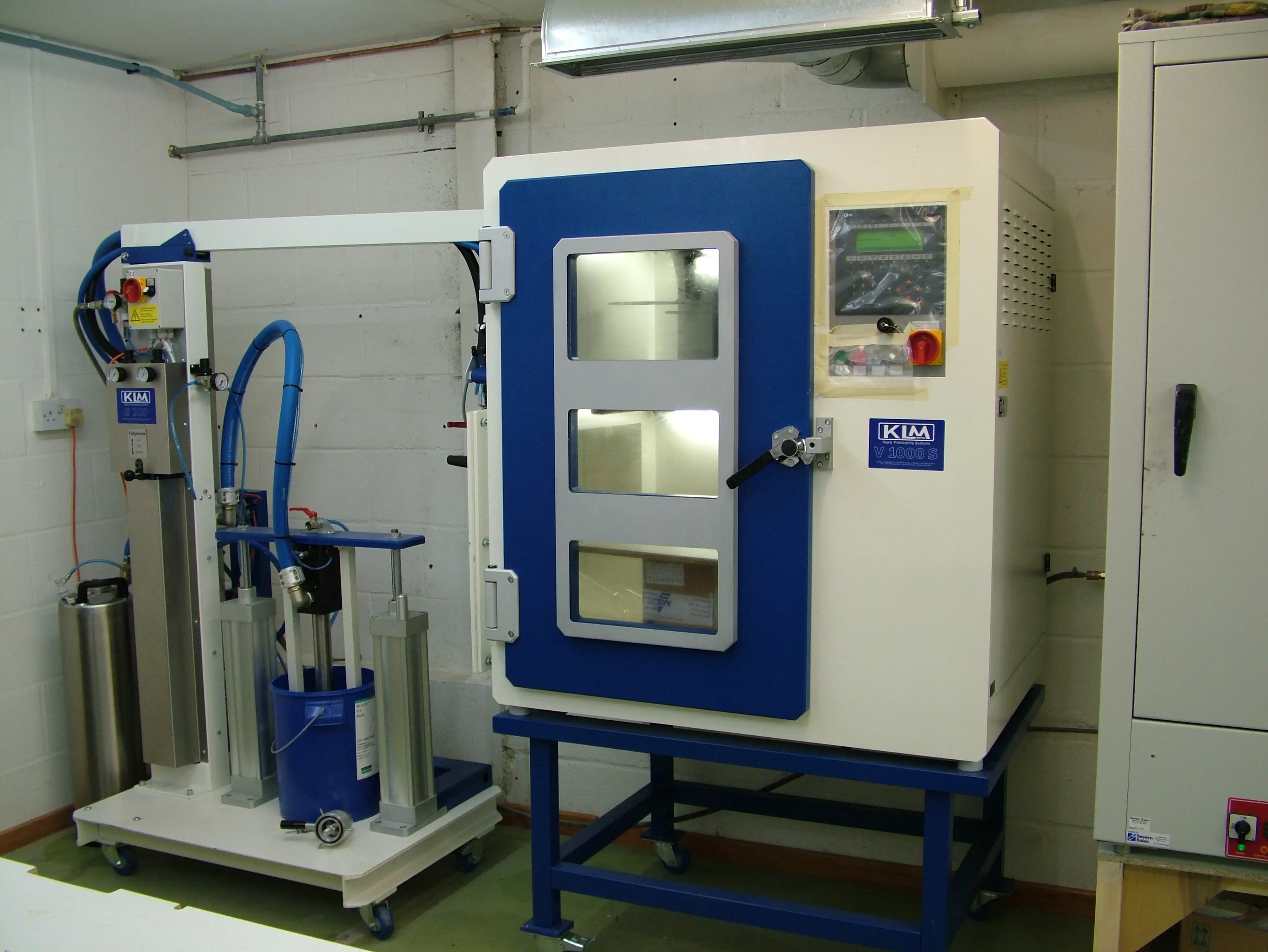
Complete Fabrication has been vacuum casting since the 1980s, when David Kent began casting polyurethane resins under vacuum into silicone moulds. The company developed the process with a leading supplier of vacuum casting machines and became the first to achieve two-shot moulding in vacuum casting, using self-coloured polyurethane resins of different shore hardness. Today the casting department sits in the same building as our SLA, CNC and finishing teams in Whittlesford, near Cambridge.
We make a master pattern, usually by SLA, and build a silicone mould around it. Resin is cast into the mould under vacuum, which removes air bubbles and picks up fine detail. The result is a part that looks and behaves like injection moulding, without the cost of a metal tool.
| Lead time | Two to three weeks from pattern approval, with rush schedules for urgent R&D |
| Tolerance | ±0.5 mm on most dimensions. Complex geometry may need more discussion |
| Batch size | 10 to 50 for trials. Low hundreds for production |
| Parts per mould | Generally around 20, and more depending on the complexity of the part |
| Maximum part size | We have cast very large resin sculptures up to 2 m tall |
If you need hundreds of identical parts in a production thermoplastic, injection moulding will be cheaper per part, and we will tell you. If you need one or two parts, SLA or CNC machining is faster. Vacuum casting sits between them, and our low-volume production work often uses it to bridge the gap while tooling is made.
Owlstone's breath analyser casework was vacuum cast in self-coloured, chemical-resistant polyurethane to bridge the trials phase into manufacture. Early work with the Whittle Laboratory at Cambridge University added Kevlar fibres to vacuum-cast turbine blades and increased prototype blade strength by a factor of five.
Send your CAD or master pattern to Info@compfab.co.uk or call +44 1223 836837, and tell us the quantity and finish you need.
Most projects are completed in two to three weeks from pattern approval. We offer rush schedules for urgent R&D and always give a firm timeline up front.
We maintain ±0.5 mm on most dimensions. Complex geometries may need further discussion.
Vacuum casting suits batches of 10 to 50 parts for trials and testing, and low-volume runs in the low hundreds. A silicone mould generally gives around 20 castings, and more depending on the complexity of the part.
Yes. We use polyurethane resins that mimic production plastics, including biocompatible and clear resins suitable for medical housings and fluid-handling components.
Yes. We cast self-coloured parts with colour all the way through, in opaque, translucent or clear grades. Parts can also be painted, textured or printed.
When you need hundreds or thousands of identical parts in a production thermoplastic and the design is settled. Vacuum casting suits the stage before that.
See also:3D printing in Cambridge, medical device prototyping, casting materials and data sheets, what affects the price and rapid prototyping FAQs. To get a quote, contact us.